The European Commission announced Regulation (EU) 2023/1542 "Regulation on Batteries and Waste Batteries" on July 12, 2023. It officially entered into force on August 17, 2023. The old Battery Directive 2006/66/EC will be repealed starting from August 18, 2025.
The main scope of control applies to all batteries placed on the market, which must comply with the following requirements:
| Requirements |
Portable Batteries |
Light Means of Transport Batteries
(LMT Batteries) |
Starting, Lighting, and Ignition Batteries
(SLI Batteries) |
Industrial Batteries |
Electric Vehicle Batteries |
| Restrictions on Hazardous Substances (Article 6) |
● |
● |
● |
● |
● |
| Carbon Footprint (Article 7) |
|
● |
|
● |
● |
| Recycled Content (Article 8) |
|
● |
● |
● |
● |
| Performance and Durability (Articles 9 & 10) |
● |
● |
|
● |
● |
| Removability and Replaceability (Article 11) |
● |
● |
|
|
|
| Safety of Stationary Battery Energy Storage Systems (Article 12) |
|
|
|
● |
|
| Labelling of Batteries (Article 13) |
● |
● |
● |
● |
● |
| Information on State of Health and Expected Lifetime (Article 14) |
|
● |
|
●
(Stationary storage) |
● |
| EU Declaration of Conformity (Article 18) |
● |
● |
● |
● |
● |
| CE Marking (Article 20) |
● |
● |
● |
● |
● |
| Battery Due Diligence (Chapter VII) |
● |
● |
● |
● |
● |
| Management of Waste Batteries (Chapter VIII) |
● |
● |
● |
● |
● |
| Battery Passport (Chapter IX) |
|
● |
|
● |
● |
Furthermore, economic operators (the first natural or legal person to place a battery on the market) must bear the costs of collection and treatment for the aforementioned battery types (Portable, LMT, SLI, Industrial, and EV batteries).
Restrictions on Hazardous Substances (Art. 6)
Member States shall prohibit the placing on the market of batteries containing the substances listed below, unless the concentration is below the specified limit:
| Restricted Substance |
Battery Type |
Concentration Limit |
Remarks |
| EU REACH Annex XVII |
All batteries |
Comply with Annex XVII requirements |
- |
| Mercury (Hg) |
All batteries |
Exceeding 0.0005% |
- |
| Cadmium (Cd) |
Portable batteries |
Exceeding 0.002% |
- |
| Lead (Pb) |
Portable batteries |
Exceeding 0.01% |
From Aug 18, 2024 (Not applicable to portable zinc-air button cells until Aug 18, 2028) |
Carbon Footprint and Performance Class Requirements (Art. 7)
Carbon footprint requirements are applied in three stages for LMT batteries, rechargeable industrial batteries (>2 kWh), EV batteries, and rechargeable industrial batteries with external storage functions:
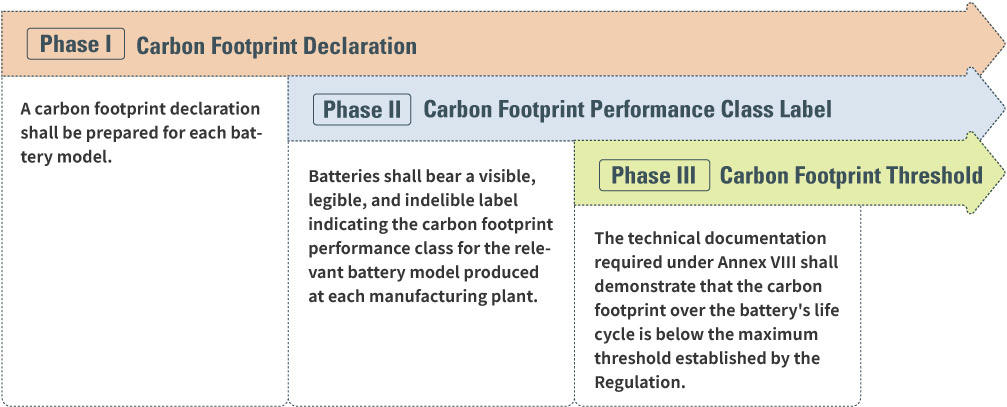 Carbon Footprint and Performance Class Requirements (Art. 7)
Recycled Content Requirements in Batteries (Art. 8)
Manufacturers of industrial batteries (>2 kWh), EV batteries, LMT batteries, and SLI batteries must indicate the recycled content in their batteries:
| Recycled Content Requirements |
LMT Batteries |
Industrial (>2 kWh), EV, and SLI Batteries |
| Regulated Element |
Regulated Part |
Recycled Proportion |
| Cobalt (Co) |
Active Materials |
>16% |
- |
Effective 2031/8/18 |
| Lithium (Li) |
>6% |
| Nickel (Ni) |
>6% |
| Lead (Pb) |
Battery |
>85% |
| Cobalt (Co) |
Active Materials |
>26% |
Effective 2036/8/18 |
| Lithium (Li) |
>12% |
| Nickel (Ni) |
>15% |
| Lead (Pb) |
Battery |
>85% |
Performance and Durability Requirements (Art. 9 & 10)
Batteries shall meet the performance and durability requirements specified in the following annexes:
- General portable batteries (excluding button cells): Refer to Annex III.
- Rechargeable industrial batteries (>2 kWh), EV batteries, and LMT batteries: Refer to Annex IV Part A.
Removability and Replaceability of Batteries (Art. 11)
Except for products specifically designed for use in environments involving water or professional medical imaging, radiotherapy, and in-vitro diagnostic medical equipment, portable batteries and LMT batteries must ensure they can be easily removed and replaced during the product's lifetime using commercially available tools or tools supplied with the product.
Safety Requirements for Stationary Battery Energy Storage Systems (Art. 12)
Stationary battery energy storage systems shall be accompanied by technical documentation (Annex VIII) proving compliance with the safety test parameters set out in Annex V.
Labelling Requirements for Batteries (Art. 13)
All batteries placed on the market must be labelled in accordance with Article 13. Article 13 corresponds to the marking details in Annex VI, where item 10 requires the disclosure of critical raw materials with a concentration >0.1% (w/w). For the list of critical raw materials, please refer to Annex II of Regulation (EU) 2024/1252.
Information on State of Health and Expected Lifetime (Art. 14)
Stationary battery energy storage systems, LMT batteries, and EV battery management systems shall include the information specified in Annex VII.
EU Declaration of Conformity and CE Marking (Art. 18 & Art. 20)
The Declaration of Conformity (DoC) shall be drawn up in the format set out in Annex IX (including elements from Annex VIII), demonstrating that the battery has met the requirements for sustainability, safety, labelling, and information.
Before placing a battery on the market, the CE marking shall be affixed, followed by the identification number of the notified body carrying out the conformity assessment.
Digital Battery Passport (Art. 77)
Industrial batteries (>2 kWh), EV batteries, and LMT batteries must provide Digital Battery Passport information. Article 77 corresponds to the Digital Battery Passport requirements in Annex XIII, where (b) requires disclosure of critical raw material information. For critical raw material items, please refer to Annex II of Regulation (EU) 2024/1252.
Have questions about regulations or testing?
Write them here, and a specialist will reply to you!
Contat Us