What
What is JEITA VOC?
JEITA VOC refers to a set of emission standards and testing guidelines for Volatile Organic Compounds (VOCs) in electronic products (specifically PCs and displays) established by the Japan Electronics and Information Technology Industries Association (JEITA). This specification was developed in response to strict indoor air quality requirements from Japan's Ministry of Education, Culture, Sports, Science and Technology (MEXT) and the Ministry of Health, Labour and Welfare (MHLW). Unlike traditional testing, the JEITA specification converts indoor concentration levels of 8 key VOCs into specific emission rate limits for individual electronic devices.
Expert Tip: Not sure which standard applies to your product or worried about calculation errors? SGS can provide precise conversions and compliance determinations for you.
JEITA VOC Specification List
| Analyte Name |
CAS NO. |
Tablet |
Laptop PC |
All-in-one PC |
Desktop PC |
Display |
| Toluene |
108-88-3 |
266 |
260 |
260 |
130 |
130 |
| (m/p/o-Xylene) |
- |
200 |
200 |
200 |
100 |
100 |
| p-Dichlorobenzene |
106-46-7 |
240 |
240 |
240 |
120 |
120 |
| Ethylbenzene |
100-41-4 |
3800 |
3800 |
3800 |
1900 |
1900 |
| Styrene |
100-42-5 |
220 |
220 |
220 |
110 |
110 |
| Tetradecane |
629-59-4 |
330 |
330 |
330 |
165 |
165 |
| Formaldehyde |
50-00-0 |
100 |
100 |
100 |
50 |
50 |
| Acetaldehyde |
75-07-0 |
48 |
48 |
48 |
24 |
24 |
- Unit: (µg/h·unit) uses mass emission per hour (µg/h·unit) as the evaluation index under controlled temperature, humidity, and ventilation conditions.
- Source: VOC Emission Rate Specification for Personal Computers and Tablet Devices (Ver. 2)
- Compliance Testing: Based on ISO/IEC 28360, placing the device in a chamber to evaluate 8 VOCs under "Actual Operation" conditions.
- General Testing: Content testing of the 8 VOCs in the product following sample pre-treatment.
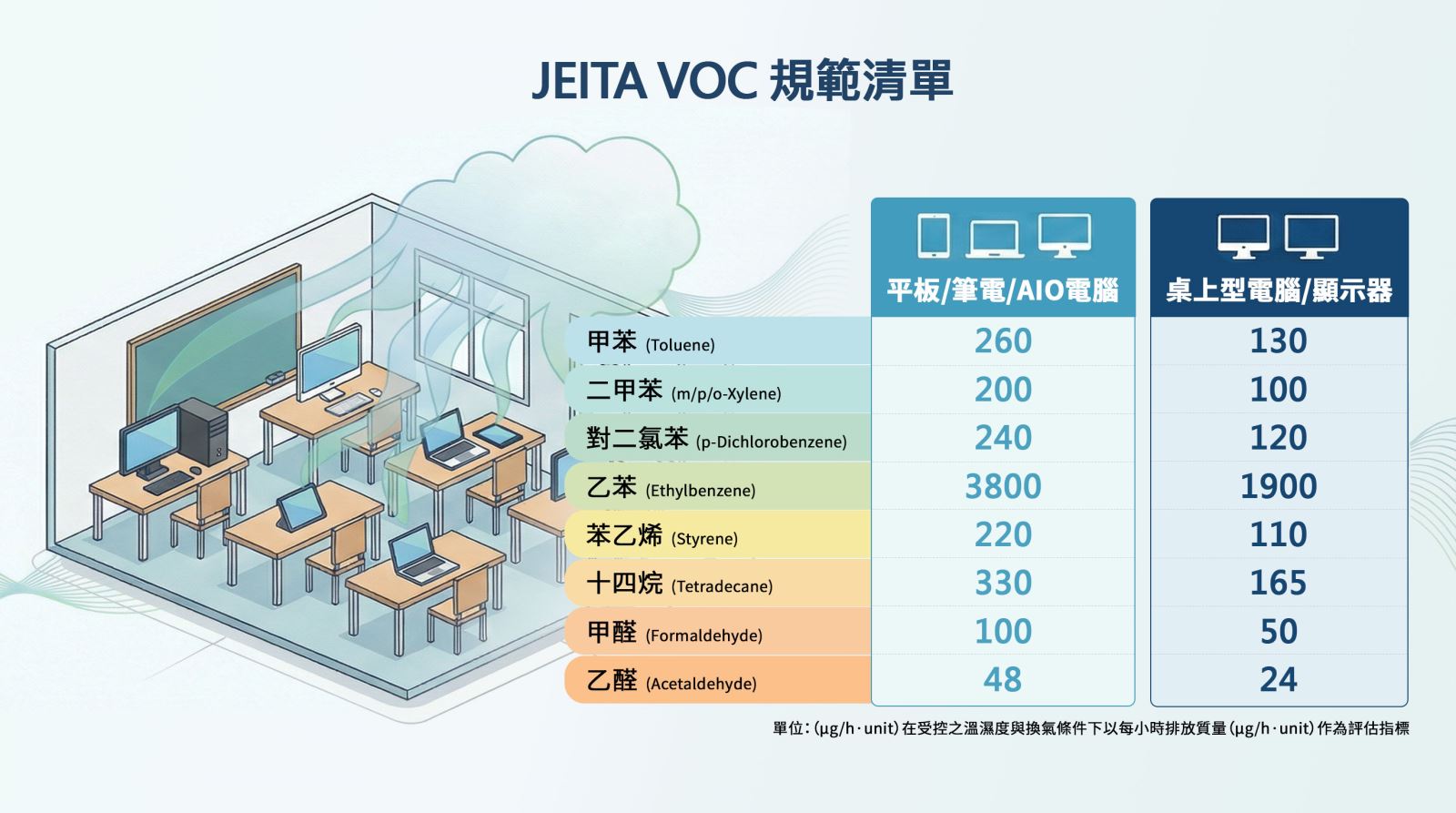 JEITA VOC Specification List
Why
Why should companies perform JEITA VOC testing?
In an international trade system that highly values "Environmental Friendliness" and "Health and Safety," JEITA VOC testing has become a globally recognized indicator for low chemical emissions and manufacturing quality, no longer limited to the Japanese market.
Internationally Recognized Low Emission Standards
JEITA VOC testing is harmonized with ISO/IEC 28360, serving as objective proof that electronic products meet international chemical emission and indoor air quality requirements. Reports satisfy not only the Japanese market but are also applicable to high-standard markets in Europe, North America, and Asia.
Supporting ESG and Green Procurement Decisions
Assists brands and suppliers in passing ESG and sustainable supply chain audits, facilitating entry into high-value procurement projects for commercial and educational sectors.
Proactive Supply Chain Risk Warning Management
Through early-stage VOC testing, risks from changes in materials or processes (such as adhesives, coatings, or various materials) can be identified early, reducing the likelihood of non-compliance, product recalls, and reputational damage.
How
How to perform JEITA VOC testing?
We utilize the Environmental Test Chamber method in accordance with ISO/IEC 28360 to simulate product emission behavior in real-world environments.
Why do you need expert assistance?
Testing is not simply putting a product in a box. JEITA specifications have extremely strict definitions for "Operational States."
The key lies in "Worst-Case Scenario" settings
Failure to correctly configure the operating system, power management, and hardware load will result in test data being judged invalid. The SGS expert team can help confirm your product is in the correct operating mode to ensure a smooth testing process.
Precise Environmental Control
We strictly control background concentrations, temperature, humidity, and air exchange rates in the test chamber to ensure data complies with standards.
Interested in learning more?
Whether you're interested in regulatory updates, testing methods, market requirements, or sustainability topics, we'd love to hear from you.
Your question may even inspire our next article, FAQ, or webinar topic.
Tell us what you'd like to learn