What
What is ESG?
ESG stands for Environmental, Social, and Governance. ESG principles are rooted in sustainability and closely aligned with the United Nations Sustainable Development Goals (SDGs).
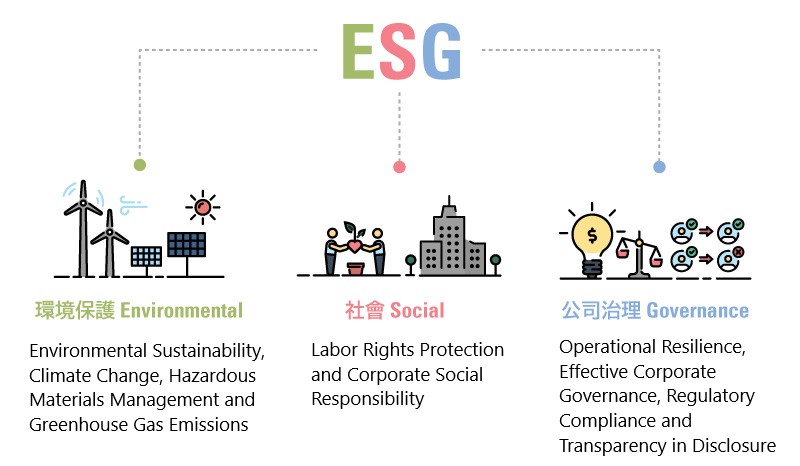
The Environmental dimension covers areas such as pollution reduction and waste management. The Social dimension addresses labor rights, employee welfare, and community engagement. The Governance dimension focuses on operational integrity, effective oversight, and regulatory compliance.
Given the broad scope of ESG, many organizations begin their ESG journey with the Environmental dimension — such as establishing a comprehensive hazardous substance management system, ensuring electronic products meet WEEE compliance requirements, conducting greenhouse gas inventories, and assessing product carbon footprints.
 ESG
How is ESG different from CSR and SDGs?
When people talk about ESG, CSR is often mentioned as well.
CSR (Corporate Social Responsibility) as defined by the World Business Council for Sustainable Development (WBCSD), reflects a company's commitment to ethical economic development and enhancing the quality of life for employees, local communities, and society at large.
While CSR defines the broader vision of corporate responsibility, ESG provides the measurable framework through which these commitments are put into practice.
The Sustainable Development Goals (SDGs) were established by the United Nations in 2015. Comprising 17 goals and 169 targets, the SDGs provide a shared blueprint for governments, businesses, and individuals to collectively advance sustainable development.
ESG is the measurable framework that evaluates corporate sustainability and a key benchmark for investment decision-making, offering a structured, quantifiable means of operationalizing CSR commitments. By integrating ESG with the SDGs companies can enhance their operational sustainability and generate significant social impact.
Who
Who needs ESG?
As environmental and social challenges continue to grow, ESG has emerged as a become an essential strategy for sustainable business planning. Companies that emphasize environmental sustainability, labor rights, stable operations, good governance, and regulatory compliance gain advantages in aligning with international standard. As global ESG trends rise sustainability responsibilities now extend across entire value chains.
Consequently, ESG is no longer the exclusive concern of multinational giants like Apple, TSMC, and Foxconn, but for small and medium-sized enterprises to pay attention to and invest in ESG initiatives early.
Why
When Should Organizations Begin Investing in ESG?
Global climate change is an undeniable reality, marked by rising sea levels and extreme weather events worldwide. While international organizations and governments work toward greater environmental harmony, companies are increasingly expected to conduct business in an environmentally responsible manner. Environmental responsibility may seem unrelated to business profits, but it deeply affects supply chains, multinational operations, and directly impacts revenue. Furthermore, the rise of social media amplifies corporate actions, where controversies or misconduct can spread rapidly and cause immediate reputational damage. ESG allows companies to comprehensively reduce these risks and achieve their sustainable business goals. In other words, ESG is the most effective strategy for both environmental and corporate sustainability.
Interested in learning more?
Whether you're interested in regulatory updates, testing methods, market requirements, or sustainability topics, we'd love to hear from you.
Your question may even inspire our next article, FAQ, or webinar topic.
Tell us what you'd like to learn